How much do HVAC refrigerant leaks harm the environment?
HVAC leaks harm the environment a ton! HVAC refrigerant leaks have an astronomical climate impact even at small quantities, and they also waste electricity.
Here’s how HVAC refrigerant leaks hurt the planet:
Direct (refrigerant) impact. Many HVAC refrigerants are potent greenhouse gases. For example, EPA lists 100-yr GWPs of R-410A = 2,088, R-134a = 1,430, and R-32 = 675 (vs. CO₂ = 1). EPA
Rule of thumb: 1 lb leaked →
• R-410A ≈ 0.95 tCO₂e; 10 lb ≈ 9.47 tCO₂e (~the annual emissions of ~2 passenger cars). EPA+1
• R-134a ≈ 0.65 tCO₂e per lb; R-32 ≈ 0.31 tCO₂e per lb. EPA
(By contrast, newer HFO-1234yf ≈ 1 GWP, so its climate impact per lb is ~2,000× lower than R-410A.) EPAIndirect (energy) impact. Leaky/under-charged systems run less efficiently. Field studies show improper charge can cut efficiency ~10–20%, driving up electricity use and associated CO₂. Recent research also finds HVAC faults can waste 15–30% of building energy. Purdue e-Pubs+2Purdue e-Pubs+2
How common are HVAC refrigerant leaks? For typical residential/commercial split A/C, reported annual emissions (leak) rates are often ~4–5% of charge; end-of-life losses can add more. (Large supermarket refrigeration can be ~25%/yr, which shows how big the problem can get.) ASHRAE+1
Why policy cares. HFCs (the main modern A/C refrigerants) are a growing slice of greenhouse gases; the U.S. AIM Act requires an 85% HFC phasedown by 2036, and EPA is pushing lower-GWP alternatives plus leak minimization. EPA+1
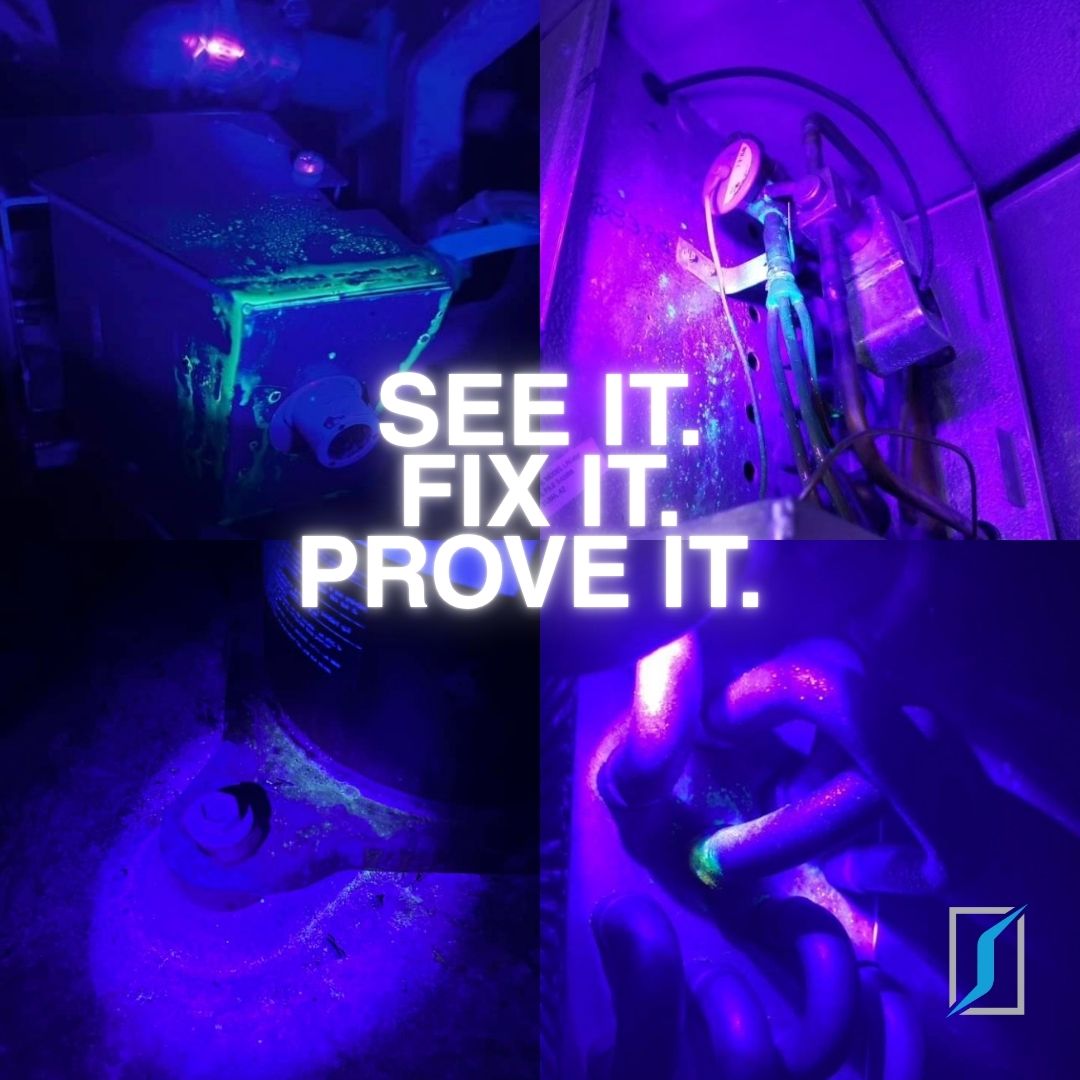
See it, fix it, verify it—less refrigerant lost, less energy wasted. Spectroline Dye is a reliable option.
It stops refrigerant from escaping sooner. UV dye circulates with the refrigerant and marks the exact leak path. Techs can see even tiny or intermittent leaks under a UV lamp, fix the right joint once, and avoid “top-off and hope” cycles that keep venting HFCs.
It shortens diagnostic time and rework. Faster pinpointing = fewer callbacks and fewer times a system gets depressurized/pressurized—both of which risk additional loss. Less handling, less leakage.
It keeps systems at proper charge. Undercharged HVAC runs hotter and less efficiently. Finding and fixing leaks restores design charge, cutting the indirect CO₂ from wasted electricity.
It enables proactive maintenance. A small amount of dye remains in the system after repair. If a new leak starts later, it’s immediately visible—so leaks are caught early instead of after months of silent emissions.
It supports compliance and proof. A UV-lit leak and a clean re-scan after the repair provide visual documentation that a leak was found and fixed—useful for ESG reporting and leak-rate rules.
The proof is in the math. Take a look at the formula below and apply it to your own situation:
CO₂e (tons) ≈ leak_lb × GWP × 0.0004536
Examples per pound: R-410A ≈ 0.95 t, R-134a ≈ 0.65 t, R-32 ≈ 0.31 t.
So stopping a 3 lb R-410A leak avoids ~2.85 tCO₂e.
Spectroline leak detection directly reduces the environmental footprint of HVAC/R systems.
Finds HVAC refrigerant leaks earlier (so less refrigerant escapes). Spectroline UV dye circulates with the refrigerant and highlights the exact leak path under a UV lamp, making pinholes and intermittent leaks obvious. Early, precise fixes prevent ongoing HFC/HFO releases.
Cuts repeat visits and venting risk. Faster pinpointing means fewer evacuate/recharge cycles and fewer callbacks—both lower the chances of additional refrigerant loss.
Restores system efficiency. Fixing leaks returns systems to proper charge, reducing the extra electricity under-charged units waste (and the indirect CO₂ from power generation).
Provides ongoing, passive monitoring. A trace amount of dye remains after repair. If a new leak starts, it fluoresces immediately—catching issues early rather than after months of emissions.
Works across today’s refrigerants and oils. Spectroline formulations are compatible with major HVAC/R refrigerants and lubricants, including modern lower-GWP blends—so programs stay effective through phase-downs and conversions.
Delivers visual proof for compliance. Bright fluorescence provides clear “found and fixed” evidence that supports leak-rate tracking, internal audits, and ESG reporting.
Scales from service to OEM. In mobile A/C, Spectroline’s Tracer Wafer places UV dye at the assembly line for built-in, day-one leak detectability—reducing field emissions and warranty churn.
Ready to try Spectroline? Email us at orders@spectroline.com or call (516) 333-4840.