Leak detection in sensitive environments: Closing the gap between “Eco Fluids” and Real-World Maintenance
Across Europe, more maintenance teams are asked to do two things at once: find leaks faster and reduce environmental risk—especially in operations that touch soil, waterways, or coastal zones.
Whether you’re running hydraulic equipment in forestry, operating deck machinery in marine applications, or maintaining lubrication systems in mining and industrial sites, small leaks can become big headaches: downtime, cleanup, reporting, and reputational damage.
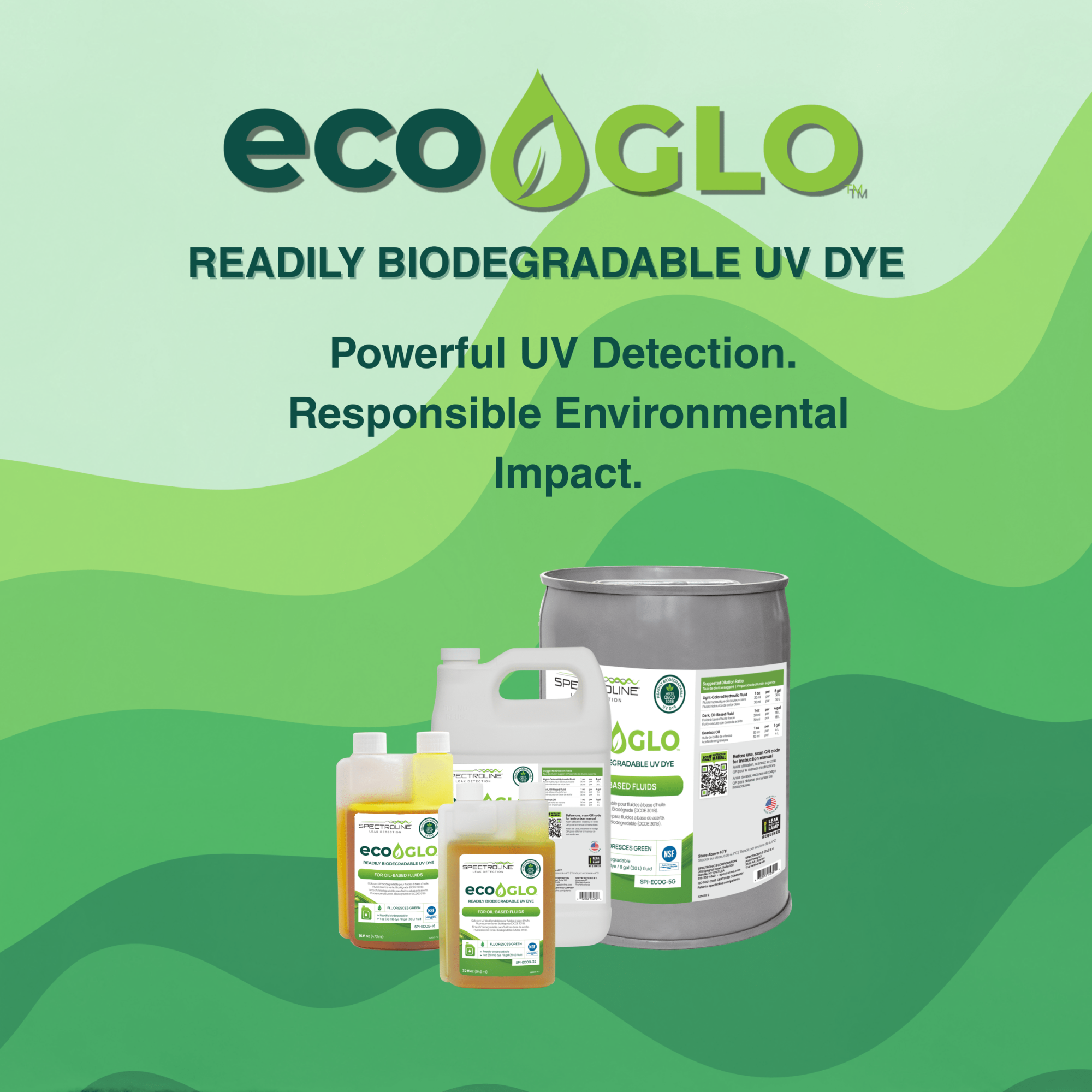
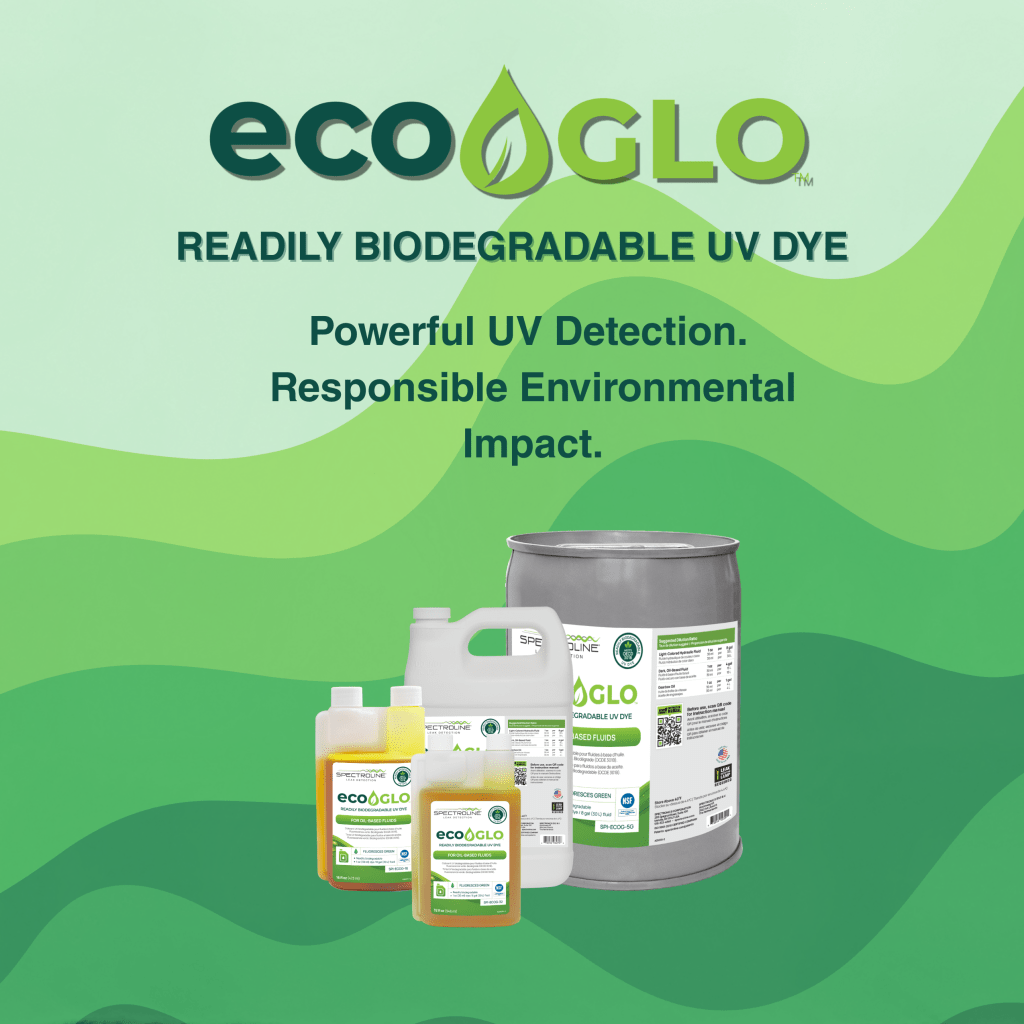
That’s exactly why we created ECO-GLO™—a patent-pending, oil-soluble UV dye engineered for closed-loop, oil-based systems, with a key difference: independently tested and shown to be readily biodegradable under an OECD “ready biodegradability” screening method (OECD 301B).
The problem with traditional leak detection in eco-sensitive sites
Fluorescent dye leak detection is already one of the fastest ways to pinpoint the source of a leak.
In sensitive environments, customers increasingly ask:
Will this product persist in the environment if a leak occurs?
Can it support EAL (Environmentally Acceptable Lubricant) programs?
Can we show credible biodegradability evidence when procurement or sustainability teams ask?
ECO-GLO™ is built for this reality:
– High visibility under UV/violet inspection lamps.
– Fully miscible in petroleum and synthetic oils.
– Filterable to 2 microns, and stable—with no phase separation or crystallization, even in harsh storage conditions.
A smart bridge to F-Gas: one facility, one leak-prevention culture
If your audience includes industrial facilities that also operate refrigeration, chillers, or HVAC equipment, you can connect the story to the broader European focus on leak prevention.
The European Commission outlines obligations around personnel training/certification for installing, servicing, and leak checking F-gas equipment—reinforcing that leak prevention is not optional in modern operations.
You don’t need to position ECO-GLO™ as an F-gas product. Instead, frame it as part of a single site-wide leak prevention culture:
refrigerant leaks → managed via F-gas compliance practices
oil/hydraulic leaks → managed via environmentally responsible, high-visibility detection methods
Same mindset. Same preventative maintenance discipline. Different systems.
What “readily biodegradable” means (and why Europe cares)
In the real world, “biodegradable” can mean a lot of things. Especially in regulated and procurement-driven environments. “Biodegradability” matters whether the claim is backed by recognized test methods and also clear pass criteria.
That is why ECO-GLO is a perfect choice as the product passed OECD 301B testing.
OECD 301 tests = “ready biodegradability” screening
The OECD 301 series is a widely used screening test for ready biodegradability. They are intentionally stringent: when a material passes, it supports the assumption that it can biodegrade rapidly.
In EU guidance frameworks for lubricant and related substance screening, definitions and criteria often refer to OECD methods. For example, the EU Ecolabel criteria for lubricants describe “readily biodegradable” as passing stringent screening tests for ultimate biodegradation and reference OECD 301 / OECD 306 / OECD 310 (or equivalent) as accepted methods.
Also important: under the EU Ecolabel’s lubricant criteria, the 10-day window principle may be waived in certain contexts. It notes that the 10-day window “will not necessarily apply” for that criterion—useful context when stakeholders are comparing “pass by Day 28” vs “pass within 10 days.”
If you operate in forestry, marine-adjacent infrastructure, mining, or any environment where leaks can become incidents, ECO-GLO™ is designed to support your goals:
Learn more about how ECO-GLO™ can be a perfect addition to your preventative maintenance plans.
Like what you see? Sign up to stay informed about ECO-GLO!
By submitting this form, you are consenting to receive marketing emails from: . You can revoke your consent to receive emails at any time by using the SafeUnsubscribe® link, found at the bottom of every email. Emails are serviced by Constant Contact